
Long after the final wagons rolled out of town and the uniforms were packed away from the winter filming in Gettysburg, the story of “Gettysburg 1863” was still unfinished.
When cast and crew departed Gettysburg in February 2026, the production was not yet at its end. In late March, the filmmaking team traveled south to San Marcos, Texas, where the powerful night sequence on the San Marcos River was filmed, a harrowing escape scene involving actor Eric Nelsen as Thomas McClean, fighting for his life against violent rapids as he escapes from being held as a prisoner of war. The controlled river environment allowed the crew to safely execute one of the film’s most physically demanding moments.
But it was back home in Pennsylvania where the production would finally breathe its last cinematic breath.
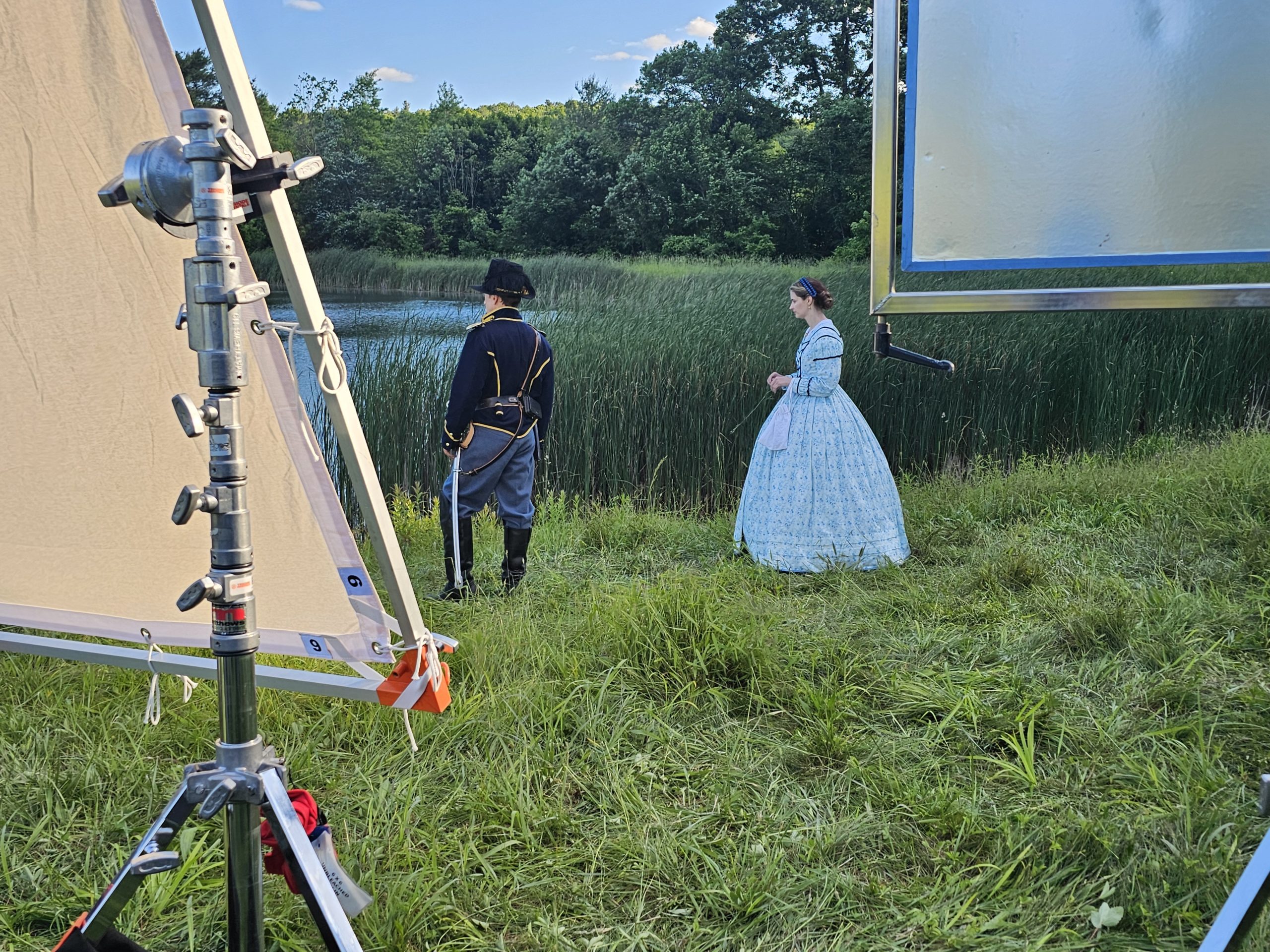
On May 30, 2026, beneath the quiet beauty of the mountains of Orrtanna, the cameras rolled one final time. Eric Nelsen and actress Hannah Galway filmed the emotional opening scene of the movie, an intimate farewell between Thomas and Hannah, a young couple forced to endure the ache of war and separation. As the final take ended, so did months of relentless production.
“Picture wrap”: Two simple words, but within the film industry they carry enormous emotional weight. Traditionally announced by the director or first assistant director, “picture wrap” signals the completion of principal photography. What follows is often a mixture of applause, exhaustion, relief and silence. It marks the end of weeks and sometimes months of grueling 12-to-16-hour days being in constant motion, pressure, weather, unpredictability and creative intensity.
Filmmaking remains unlike any other profession. Crews operate inside tightly specialized departments yet somehow become deeply bonded through shared hardship and creative purpose. In temporary communities built under pressure, strangers quickly become family. Then, almost overnight, everyone packs their vehicles, tears down the sets and disappears back into separate lives.
The transition can be jarring. Unlike traditional careers that move in steady rhythms, filmmaking happens in bursts, an exhausting sprint of production followed by the long isolation of editing rooms and postproduction work.
For many filmmakers, the days immediately following wrap are intentionally quiet. Industry veterans often schedule “soft days” with no networking, no meetings and no obligations. Sleep is restored. Bodies recover from poor nutrition and adrenaline overload.
After weeks spent beneath blinding set lights and constant noise, many seek silence, nature and stillness to calm what production leaves behind. Yet amid the exhaustion, there remains an undeniable magic in what was created together.
The Gettysburg Film Commission witnessed that firsthand this spring through its 2026 intern, Luong Nguyen, who joined the production team after completing his junior year at Gettysburg College. For a film student, stepping onto a live movie set offers an education impossible to recreate in a classroom. In January 2026, the production also hired three former interns and local film students to step into production assistance work during the filming of “Gettysburg 1863.” For many young creatives in the region, it became more than a learning experience: It became their first opportunity to work inside the demanding rhythm of a professional film set and discover what storytelling truly requires behind the camera.
To give a film student the experience of being on set is incredible. You see, in real time, everything it takes to bring movie magic together the chaos, the pressure, the weather, the actors, the moving pieces and somehow, out of all of it, a story emerges.
Luong embraced every moment of it. “For me, everything,” Nguyen said when asked what excited him most about the internship. “I will have a chance to observe film production and gain more hands-on experience. I learned that on a film set that things can get quite chaotic, and a lot can go wrong, so people must be very adaptive. The collaborative element is also very interesting. I want to see how different departments come together and produce a memorable piece of art. This experience will further enhance the knowledge and skills I obtained at Gettysburg College and prepare me for my future career.”
But for Nguyen, the summer ahead may become even more meaningful than the film set itself. Alongside Film Commissioner Kris Webb, he will begin exploring another deeply personal story, the memoir of Sam Hirayama, an 85-year-old Japanese survivor’s story who fled to Taiwan as a 6-year-old child during World War II. Before his passing, Hirayama formed a close friendship with Webb and expressed one final wish: that his story would not disappear after his death.
Now, Webb and Nguyen hope to honor that wish. Together, they will study the recently translated memoir to determine whether a screenplay can emerge from its pages, not simply retelling history but preserving memory through film. Luong, who studied a semester of filmmaking in Japan and carries a deep passion for cultural storytelling, believes the project reaches beyond cinema itself.
“As a filmmaker and film student, I deeply understand the significance of stories,” Nguyen said. “For me, the project on Sam’s book is both a professional opportunity to hone my skills in film development but also a personal chance to investigate another person’s experiences with compassion, understanding and respect for their legacy. Transforming a memoir into a film is a daunting task, because we must both feel the story Sam went through and then use visual storytelling to convey it to audiences in a beautiful and memorable way. This will certainly be a very valuable experience for me.”
And perhaps that is the true heartbeat behind filmmaking in Gettysburg. Not simply recreating battles or staging historical moments for the screen, but preserving the deeply human stories hidden beneath history itself, stories of endurance, love, separation, survival and memory.
From Civil War fields to mountain sunsets in Orrtanna, from Texas rapids to a quiet translated memoir waiting to be rediscovered, “Gettysburg 1863” is officially wrapped. But for the storytellers behind it, the journey is only beginning.
As the Gettysburg Film Commission continues building opportunities for filmmakers, students, artists and storytellers, it remains committed to preserving Gettysburg not only as a place of history, but as a place where new stories are born. As a nonprofit organization, the Gettysburg Film Commission welcomes support from those who believe in the future of independent storytelling, film education and creative community building. Consider donating to help maintain and strengthen this journey for storytellers today, tomorrow and forever.
Kris Webb is co-founder/film commissioner of Gettysburg Film Commission and administrator for Cinema Under the Stars, GFC’s community outreach event. Visit us at gettysburgfilmcommission.org.
